London and the fashion magazine: why the city still sets the pace
There are a handful of cities you can identify by their magazines alone, and London is one of them. For more than four decades the best British fashion magazines have come out of the same few square miles, carrying an attitude that is hard to mistake for anywhere else — sharper than Paris, less polished than Milan, more interested in the street than the front row. This is independent publishing at its most distinctive: titles that treat fashion as a way of reading culture rather than a catalogue of clothes. We stock a good deal of it, and the pattern is worth explaining.
What London does well is refuse to separate fashion from everything around it — music, politics, youth, the city itself. The magazines that define the scene are fashion magazines on the cover and something broader underneath.
A scene built on the street
The modern British fashion magazine was built on the straight-up: a full-length portrait of a real person, shot against a wall, wearing their own clothes. It was fashion documented rather than directed, and it set a template the city has been working with ever since. Wit over luxury cipher, the street over the front row — that distinction tells you most of what you need to know about the London approach.
That documentary instinct still runs through the UK magazines we follow. The strongest of them assume the reader is part of the culture being photographed, not an outsider being sold to. It is a flattering assumption, and it produces work with a particular looseness — the sense that the people on the page might be the people who made it.
The Dazed inheritance
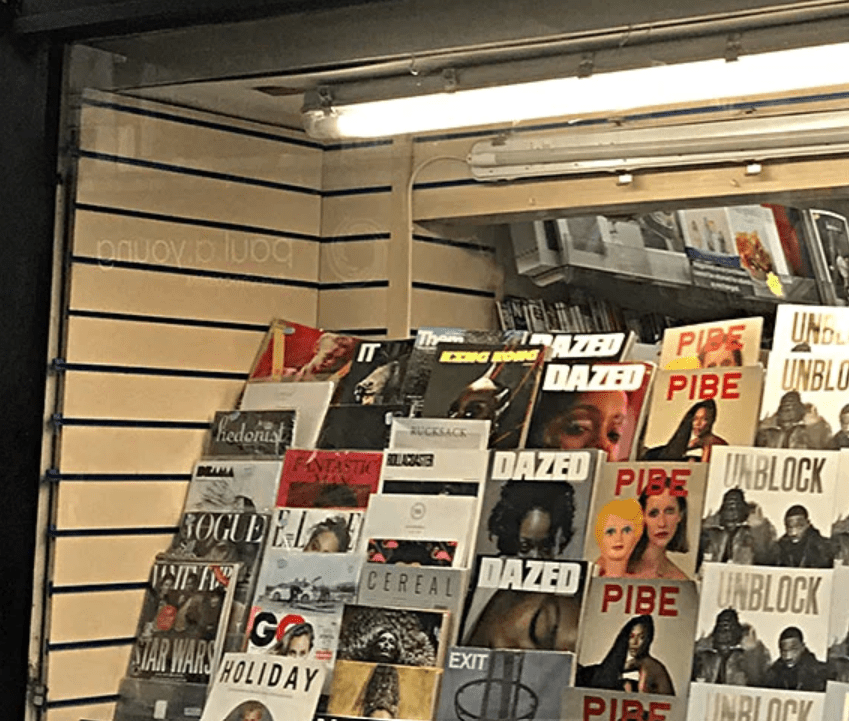
If the straight-up set the grammar, Dazed supplied the volume. Founded in London in 1991 by Jefferson Hack and the photographer Rankin, Dazed & Confused fused fashion editorial with music, film and a confrontational editorial nerve that made it the house journal of a generation. Its covers were arguments. Its photography launched careers on both sides of the lens. More than thirty years on, the title remains a reference point for anyone trying to understand how British print learned to be both fashionable and serious at once.
What the Dazed lineage gave the city was permission — to put an unknown face on the cover, to run a fashion story next to a piece of reporting, to treat the magazine as a cultural position rather than a shopping list. That confidence is the connective tissue between the older titles and the newer ones now arriving on the shelf.
The new generation
The current crop carries the inheritance in different directions. Wonderland keeps the glossy, music-led energy of London fashion close to the surface, with cover subjects drawn from the moment rather than the archive. HERO makes the case for men's fashion as a space for ideas, photographed with restraint and a strong graphic hand. A Rabbit's Foot, the newer film and culture quarterly, sits at the literary end of the same tradition — long-form, considered, as interested in the conversation as the image.
These are titles we are glad to stock and to champion. They share the London characteristic of refusing to stay in one lane: a fashion magazine that is also, at any given moment, an art magazine, a music paper or a design magazine, depending on which page you have open. That breadth is exactly why they reward keeping rather than skimming.
Beyond fashion
The overlap matters for collectors. A London fashion title sits comfortably beside the art magazines and design titles on the same shelf, because the editors think in the same idiom — image-led, culturally literate, made as objects rather than feeds. This is the part of the market that belongs with luxury magazines and books rather than disposable media: printed on good stock, designed to be looked at, still worth reading a year after the issue date. The price reflects the production, but so does the lifespan.
Why the independents matter
Titles like these stay in print for a simple reason: independent shops keep ordering them and readers keep buying them. A small-press magazine has no mass-market safety net — each issue is funded by the last one selling through. Buying from an independent rather than a feed means more of what you pay reaches the people who actually make the work, the photographers, writers and small editorial teams behind every issue. Stocking them is part of how the scene survives; reading them is the other part.
Where to begin with us
If you are building a shelf around British fashion and culture, our selection of new titles is the natural starting point — the London titles above alongside the imported independents we rate just as highly. You can buy fashion magazines online directly from the selection, or set up magazine subscriptions to the titles you find yourself returning to, which is also the most reliable way to support the small presses behind them.
London has been making fashion magazines worth keeping for forty years. The current shelf is as strong as any in that run, and most of it is a click away.